Buying a Plot in India? 12 Legal and Practical Checks Before You Pay
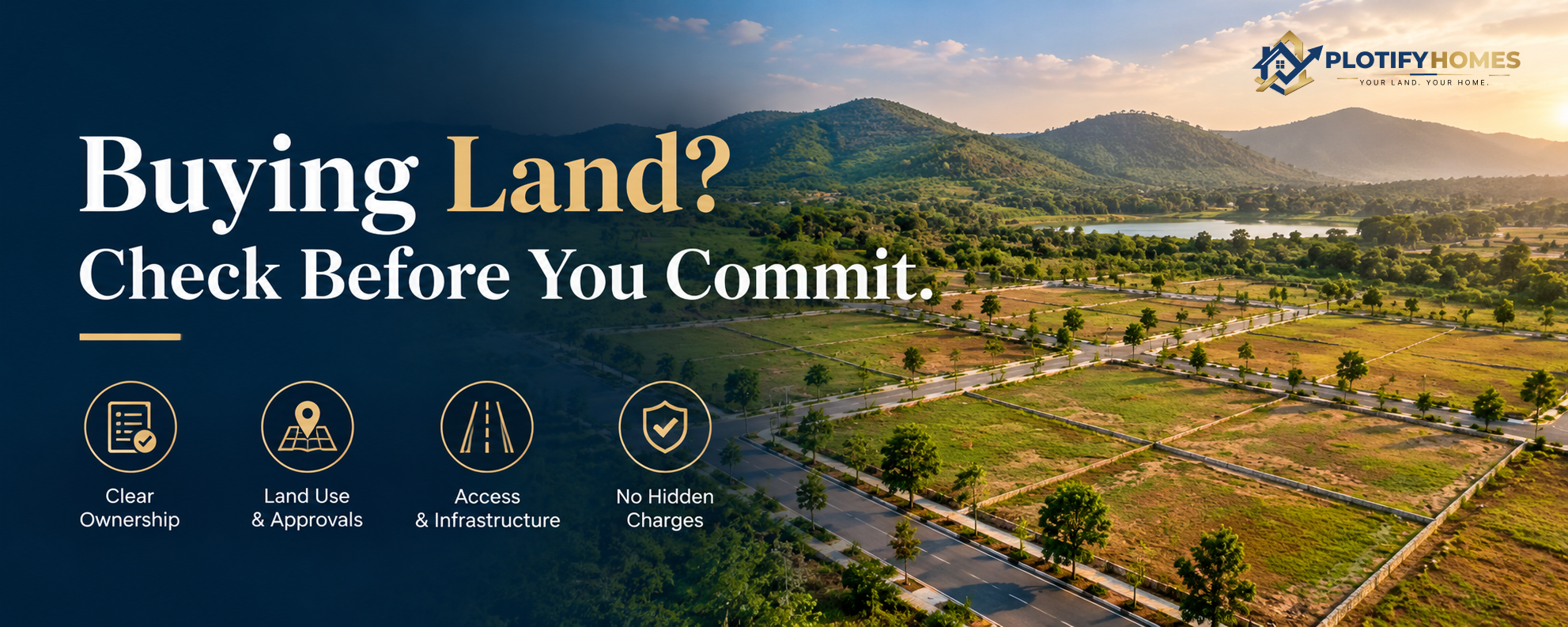
Buying a plot gives you something that an apartment often cannot: the freedom to plan your own space. Whether you are considering a residential plot, a farmhouse retreat or land for future use, the possibilities can be exciting.
But buying land requires careful verification. Two plots in the same locality can have very different legal permissions, ownership histories, access arrangements and development restrictions.
Before you pay a booking amount or sign an agreement, here are 12 checks worth making.
1. Verify who actually owns the land
The first step is to establish the legal ownership of the plot.
Ask for the registered title deed or sale deed and verify that the seller has the legal right to transfer the property. If a company, developer or representative is selling the land, confirm their authority to do so.
Check whether there are multiple owners, inherited ownership interests or any pending disputes.
2. Examine the chain of ownership
A current sale deed alone may not tell the full story.
Have a qualified property lawyer examine the previous ownership documents and transfers for an appropriate period based on local requirements.
The purpose is to identify missing links, disputed transfers or other defects that could affect the buyer's title.
3. Check land-use classification
A plot advertised as a “farmhouse plot” is not automatically approved for residential or farmhouse construction.
Land may be classified as agricultural, residential, commercial or another category under applicable state and local rules.
Ask the relevant authority or a qualified local professional to confirm:
The recorded land-use category
Whether conversion is required
Whether your intended construction is permitted
Any restrictions affecting the property
This is especially important when considering farmland or countryside developments.
4. Verify the project layout and approvals
If the plot forms part of a larger development, ask for the sanctioned layout plan and applicable approvals.
Compare the approved layout with the developer's marketing material. A proposed clubhouse, road, park or gated entrance should not be presented as an approved or completed facility without evidence.
Also verify the project's RERA registration where applicable. Some developments may fall outside registration requirements, but that should be established rather than assumed.
5. Confirm the exact plot boundaries
Never rely solely on a brochure map.
Check the plot number, recorded area, dimensions and boundaries against the relevant survey or revenue records.
Where appropriate, arrange a physical demarcation by an authorised surveyor or competent local professional.
This helps identify boundary disputes, encroachments and differences between the advertised and actual land area.
6. Verify legal road access
A plot may look attractive during a site visit but still have uncertain access rights.
Check whether the approach road is public, privately owned or dependent on a legally established right of way.
Also examine the width, condition and year-round usability of the road.
Road access should be supported by documents, not only verbal assurances.
7. Check for loans, charges and disputes
Ask your lawyer to conduct appropriate encumbrance and litigation checks using available registration, revenue and court records.
The objective is to identify mortgages, charges, claims, attachments or legal disputes affecting the property.
An encumbrance certificate can be useful, but it should not be treated as the only proof of clear title.
8. Understand the complete purchase cost
The advertised price per square yard is not necessarily the final amount you will pay.
Depending on the project and jurisdiction, additional costs may include:
Stamp duty and registration charges
Preferred-location charges
Development or infrastructure charges
Maintenance deposits
Applicable taxes and professional fees
Request a written, itemised cost sheet before making any payment.
9. Confirm utilities and infrastructure
Ask about electricity, water supply, drainage, internal roads and waste management.
Distinguish between infrastructure that is already operational and infrastructure the developer intends to provide later.
If the plot is in a remote location, also investigate ongoing maintenance responsibilities and service availability.
10. Visit the site and examine its surroundings
Online photographs cannot replace a physical site visit.
Inspect the actual plot, approach roads, neighbouring land, terrain and visible drainage conditions.
For hillside or rural properties, investigate slope stability, flood exposure, environmental restrictions and other location-specific risks where relevant.
A visit during different weather conditions may reveal issues that are not obvious on a sunny day.
11. Review the payment schedule and refund terms
Before paying a booking amount, understand exactly what happens if the transaction does not proceed.
Review the proposed agreement for payment milestones, possession or handover obligations, cancellation rights, refund provisions and responsibility for obtaining approvals.
Avoid relying on promises that are not recorded in writing.
12. Evaluate the purchase for your actual purpose
Not every attractive plot is suitable for every buyer.
If you want to build a home, construction permissions and infrastructure may matter most.
If you want a weekend farmhouse, legal land use, access and maintenance deserve particular attention.
If your objective is long-term investment, examine market demand, liquidity, transaction costs and the possibility that prices may not rise as expected.
The right plot is one that fits your requirements after verification—not simply the one with the strongest sales pitch.
A final checklist before paying
Before committing funds, make sure you have independently verified ownership, title history, land use, approvals, plot dimensions, road access, encumbrances, total costs and contractual terms.
Use a qualified property lawyer and relevant local professionals for document and technical checks.
Explore properties with Plotify Homes
At Plotify Homes, we believe property decisions deserve careful consideration.
Whether you're exploring residential plots, farmhouse land or other property opportunities, our approach begins with understanding your requirements and helping you ask the right questions.
Find a property worth owning.
Explore available properties at www.plotifyhomes.in.
Disclaimer: This article provides general educational information, not legal, tax or investment advice. Property laws, land records, conversion rules, approvals and registration requirements vary by state and location. Buyers should obtain independent professional advice and verify documents with the relevant authorities before entering into a transaction.
Plotify Homes
Looking for a plot or a home?
Browse owner-verified listings, or talk to our team about the right property for your budget.